


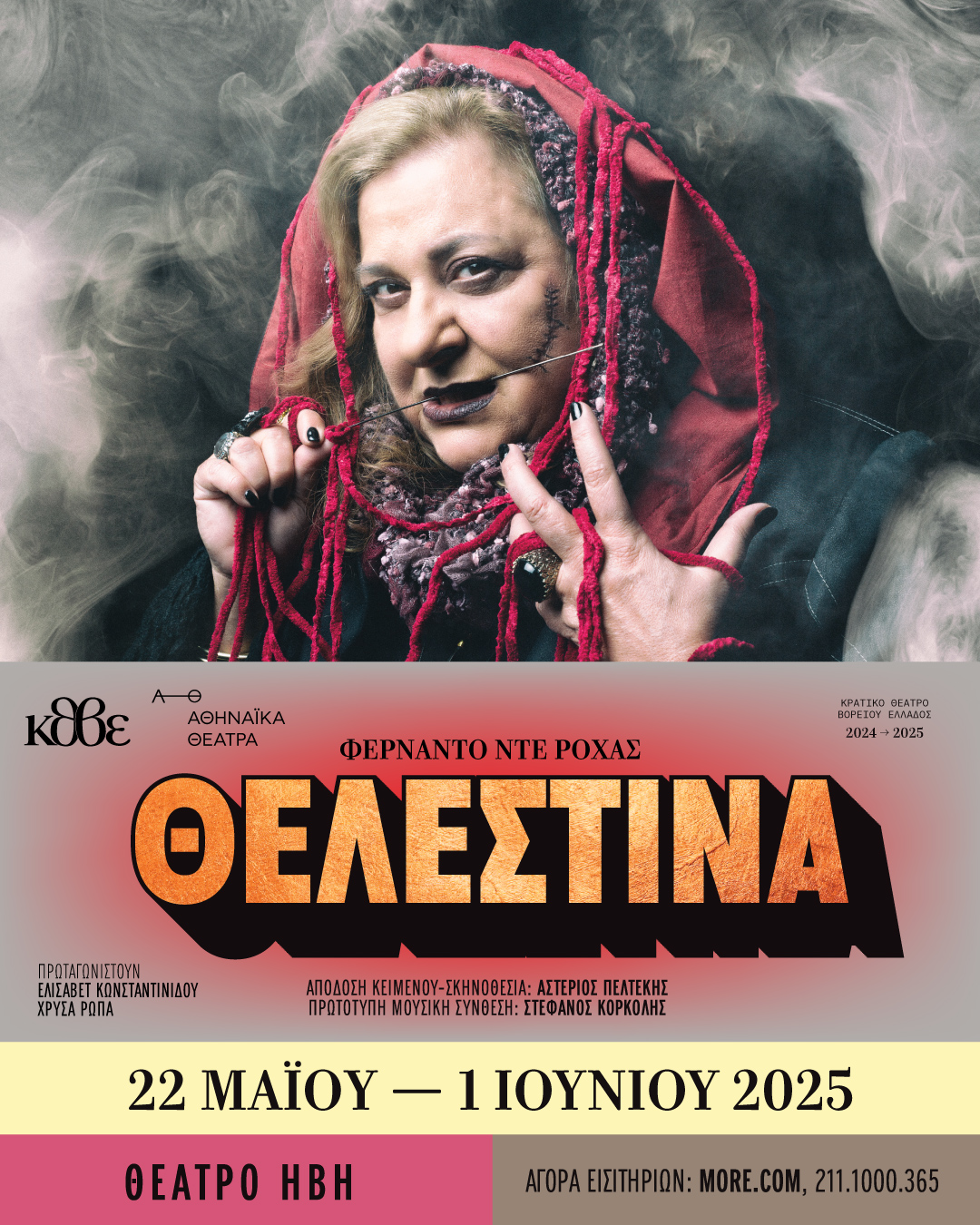
at the IBI Theater
CO-PRODUCTION: KTHB – ATHENS THEATERS
” “Telestina,” a groundbreaking work that remains strikingly relevant five centuries after it was written, as it serves as a “fresco” of human nature, filled with carnal desire, pleasure, delusion, and redemption. Comic moments alternate with dramatic ones in a theatrical interplay of guilty secrets, revelations, and plot twists that keep the audience’s interest unwavering.
A “tragicomedy” full of sorcery, deceit, intense passions, and deadly sins, which transports the audience to the superstition-ridden society of15th-century Spain, masterfully “exploring” human weaknesses, greed, lust, and love.
“Thelestina”— asthe public called it—became the accepted title, was published in 1499, featuring elements that were daring for the time, which continue to amaze and thrill readers. In this particular directorial approach to the play, through the addition of a contemporary “Transgression,” the following are further emphasized: the status of women, the “virtue” of chastity and its exploitation, as well as the massive enterprise of manipulation and commodification of the female body throughout the centuries.
Dolls crafted by visual artists from Northern Greece who responded to the invitation from the National Theater of Northern Greece and created works of art that “come to life,” curated by Froso Lytra, as the audience witnesses a procession of symbols, figures, and ideas that highlight the sexist treatment of women and the social oppression they have endured throughout history.
*Suitable for viewers 13 and older
Note from the Director and Artistic Director of the National Theater of Northern Greece
This was the comedy—or tragicomedy—of Callisto and Melibea, written for the edification and guidance of those madly in love, who, at the mercy of their passion, worship their lovers instead of God.
Calisto, a young knight in love, unable to cope with the rejection by his beloved Melibea, takes the advice of his servant Sembronio and seeks help from Telestina, a shrewd matchmaker, a former courtesan and now a pimp, who knows the secrets of love and solves problems—for a fee—using alchemy and magical herbs. Thelestina puts her plan into action so that the young couple will fall passionately in love. Cunning, manipulative, and exceptionally skilled at understanding people and exploiting their weaknesses, she employs unorthodox methods, schemes, and “tricks” of every kind that debase pure “Platonic” love and entangle the protagonists in unpredictable adventures…
What will be the outcome of this powerful love, which—through alchemy and deception—sparks a series of deadly sins, such as lust and greed, in a society rife with superstitions in15th-century Spain?
*The Celestina*, or the tragicomedy of Calisto and Melibea, is the first dialogic novel that essentially ushered in the Renaissance in literature. Fernando de Rojas, a Jew who had been forcibly converted to Christianity, wrote a captivating love story that reflects medieval morality by depicting its fundamental characteristics. Yet he finds himself on the threshold of a new era that is beginning to emerge with new codes. Amid feudalism and Catholicism, the first signs of the Renaissance and capitalism begin to emerge, in a text that pushes the boundaries of the Inquisition. This extensive novel, comprising approximately 65,000 words, enjoyed enormous success, with numerous reprints and adaptations. The text’s intense theatricality, its powerful monologues, its dialogic form, and its multifaceted characters have provided fertile ground for numerous attempts at stage adaptation. Satire, the poetic element, the combination of the sublime and the vulgar, the great passions and emotions alongside their simultaneous comic deconstruction, achieve a skillful social critique of the era, discreetly deconstructing the principles that govern it, in a text that superficially grants them legitimacy.
Asterios Peltekis
Here’s what they wrote about the performance:
“…The National Theater of Northern Greece’s production of *Thelestina* is a powerful and subversive theatrical experience that uniquely combines psychological tension, romantic tragedy, and the uncompromising power of human nature. Directed by Asterios Peltekis, the cast’s exceptional performances, and the stunning set and musical compositions create a work that captures the audience on the canvas of their own personal contradictions and desires…”.
Maria Mourouzidou, Townsendia
“…A strong cast and a well-thought-out adaptation here come together to create a powerful production—a story that may have been the Spanish precursor to Shakespeare and one of the earliest tragicomic works, rather than a conventional, classical chivalric spectacle; yet the KTHB production is a success because it vividly portrays the universal approach to love, romance, and unconfessed passions, those age-old afflictions of human existence…”. Pavlos Lemontzis, Thes.gr
“…With direction full of rhythm, humor, and boldness by Asterios Peltekis, ‘Thelestina’ dissects human greed, love, power, and deception in a direct, theatrically inventive, and thoroughly enjoyable way. A deeply human play that becomes a theatrical celebration thanks to the exceptional performances—notably those of Elisavet Konstantinidou, Chrysa Ropa, and Dimitris Morfakidis. We wholeheartedly recommend seeing it while it’s still running, as it is one of the most dynamic and well-rounded productions of the year. (…) “Telestina”—a production that exceeds expectations, revitalizes the KTHB’s repertoire, draws audiences to the theater, and offers a taste of theater just as we love it: lively, authentic, and meaningful.
Anastasios Nestoras, StellasView.gr
Distribution:
Zoe Efthymiu ( Young Telestina/Telestina II/Passing Stranger), George Kolovos ( Callisto), Thanos Kontogiorgis ( Sembronio/Tristan/Passerby), Elisavet Konstantinidou ( Telestina), Christina Konstantinidou ( Alice/Prostitute/Third Telestina/Passing Character/in a dual role), Tatiana Melidou ( Melibea), Dimitris Morfakidis ( Parmenos/Sosia/Passerby), Alexandra Palaiologou ( Areusa/Passerby), Chrysa Ropa ( Elisia), Miltos Samaras ( Tendurio/Passerby), Evi Sarmi ( Lucrecia), Eleftheria Tetoula ( Alisa/Prostitute/Third Telestina/Passing Character/in a dual role), Taxiarchis Chanos ( Plebierio/Passing Character)
The following visual artists are participating with their works: Maria Adamou, Petros Anastasiou, Evita Voudouri, Savvina Zikou, Vasiliki Karapanagiotidou, Alexandra Baltsi, Eleni Perantzakis, Argyris Stefanou, Raphael Tsiflidis, Chrysanthi Tryfon, Stratis Hatziefstratiou, Smaro Takhmatzidou, Thomis Papadimitriou
Dates: Friday, September 26
Group Reservations Department: 2111026277 & 210 2117240 ext. 305 ( weekdays from 11:00 a.m. to 7:00 p.m.) – email: [email protected]

